Tahitian Noni · Journal · From a fruit nobody wants to eat to a litre you will finish
From a fruit nobody wants to eat to a litre you will finish
A tree that fruits all year, fruit picked hard and ripened until it collapses, a purée nobody could drink, and the two named juices that turn it into something you finish. Six steps, and what each one protects.

Pick a noni fruit off the tree and take a bite, and you will spit it out. That is not squeamishness; it is the normal reaction, and it is the fact every noni bottle in the world is built around. The distance between the fruit on the branch and something you would pour over ice at seven in the morning is longer than for any other juice on your shelf. Six steps close it, and each one is there for a reason you can taste.
The tree does not have a season
Noni grows to the size of a garden tree and carries flowers and fruit at the same time, all year round. Walk past one in April and again in November and you will find fruit on both visits, at every stage from hard green to collapsing white. Anyone used to a stone fruit orchard finds this disorienting: there is no harvest week, no run-up, no glut.
For the people who pick it, that changes the whole shape of the work. Picking noni is not a season, it is a round. The tree is walked, the fruit that has reached the right hardness comes off, and the rest is left for the next pass. There is no single day when everything must be brought in, and no year when frost takes the crop.
It also explains why noni was a famine food across the Pacific long before it was a bottled one. When the good food ran short, there was always noni. Nobody chose it. It was simply always there, which over centuries is a kind of reliability that beats flavour.
Picked hard, not ripe
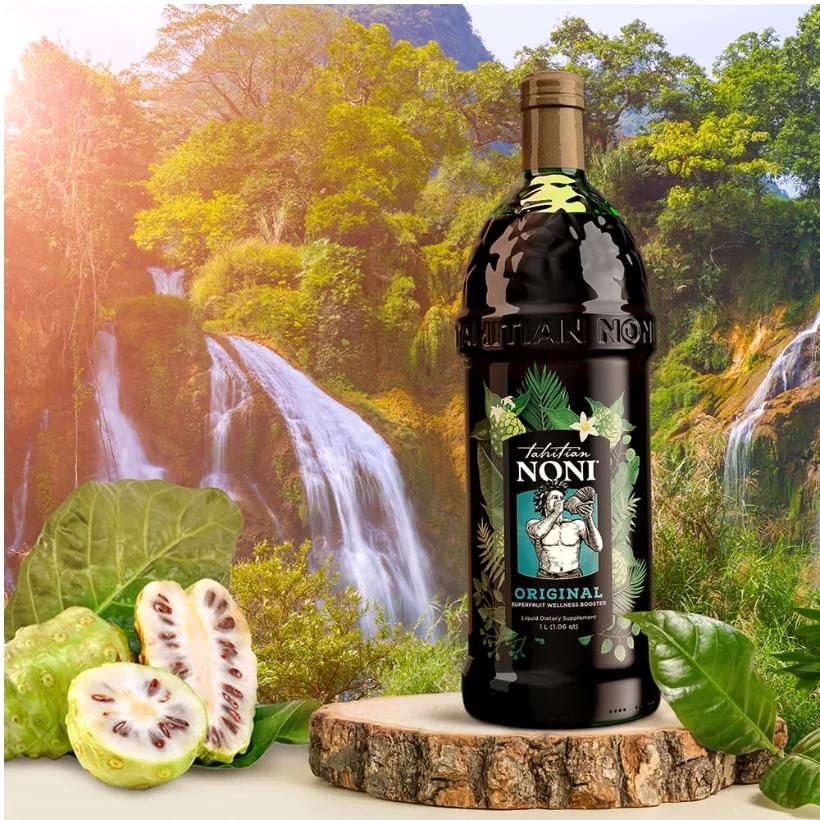
Fruit meant for juice comes off the tree while it is still firm and pale green, well before it is anything you could call ripe. This is the opposite of how you would treat a peach, and it is deliberate. A noni fruit picked soft has already begun to break down on the branch, in the sun, with insects on it. A fruit picked hard travels, and finishes breaking down where somebody is watching.
The window is narrow. Too early and there is not enough in the fruit to be worth pressing. Too late and it has started without you.
Ripened until it gives up
What happens next has no equivalent in the rest of the juice aisle. The fruit is held until it turns from white to translucent and softens to the point of collapse. Enzymes in the fruit do the work. The smell that comes off a room of ripening noni is sharp and cheesy and unmistakable, and everyone who has worked around it has a phrase for it, none of them printable in a product description.
That stage is not a fault. It is the stage the juice comes from, and a noni juice made from fruit that never got there is a different drink with the same name on it.
Pressed to a purée
The collapsed fruit is pressed and strained. Out comes a thick grey-brown purée, and it is worth being clear about what leaves this step: not a drink. Nobody could pour that into a glass and finish it. The purée is a raw material, and every bottle of noni juice sold anywhere is the story of what the maker did with it next.
Two roads lead out of here. One is to dilute the purée with water, add sugar or a sweetener, colour it back to something appetising, and put a photograph of an island on the label. The other is to blend it with real fruit juice and print what you used. Our panel names the second road: noni fruit nectar from purée, from French Polynesia, blueberry juice concentrate, grape juice concentrate, natural flavors. Four names. No water listed, no cane sugar, no preservative.
| Step | What happens | Why it is done that way |
|---|---|---|
| Picked | Fruit taken off firm and pale green, tree walked in rounds | The tree fruits all year, so there is no harvest week; hard fruit travels, soft fruit does not |
| Ripened | Held until translucent and collapsing | This is the stage the juice comes from; skipping it gives a different drink |
| Pressed | Pressed and strained to a thick purée | The purée is the raw material, not the product |
| Blended | Blueberry and grape juice concentrates go in | Unblended noni is not a drink most people finish |
| Bottled | One litre, dark glass, screw cap | Light ages juice fastest; glass keeps oxygen off a drink with no preservative |
| Dated | Cap, label, batch number | After this the bottle travels, and the panel is the only figure that still travels with it |
The panel on every bottle we sell names the same four ingredients in the same order.
Blended, and why that is not a compromise
There is a purist argument in the noni world that says a hundred per cent noni juice is the honest product and anything blended is watered down. It sounds right and it is worth taking apart.
Blueberry and grape juice concentrate are not filler. They are fruit juices with their own sugars and their own colour, and they cost money to put in a bottle. If the goal were to stretch a purée, water is free and sugar is nearly free, and neither appears on our panel. What the two concentrates buy is a drink somebody will still be drinking in week three, and a purist bottle that gets abandoned after four servings has done nobody any good.
The number that settles it is on the panel: 2 grams of sugar per 30 millilitre serving, 15 calories. Whatever the blend is doing, it is not sweetening its way past the fruit.
Four-bottle case
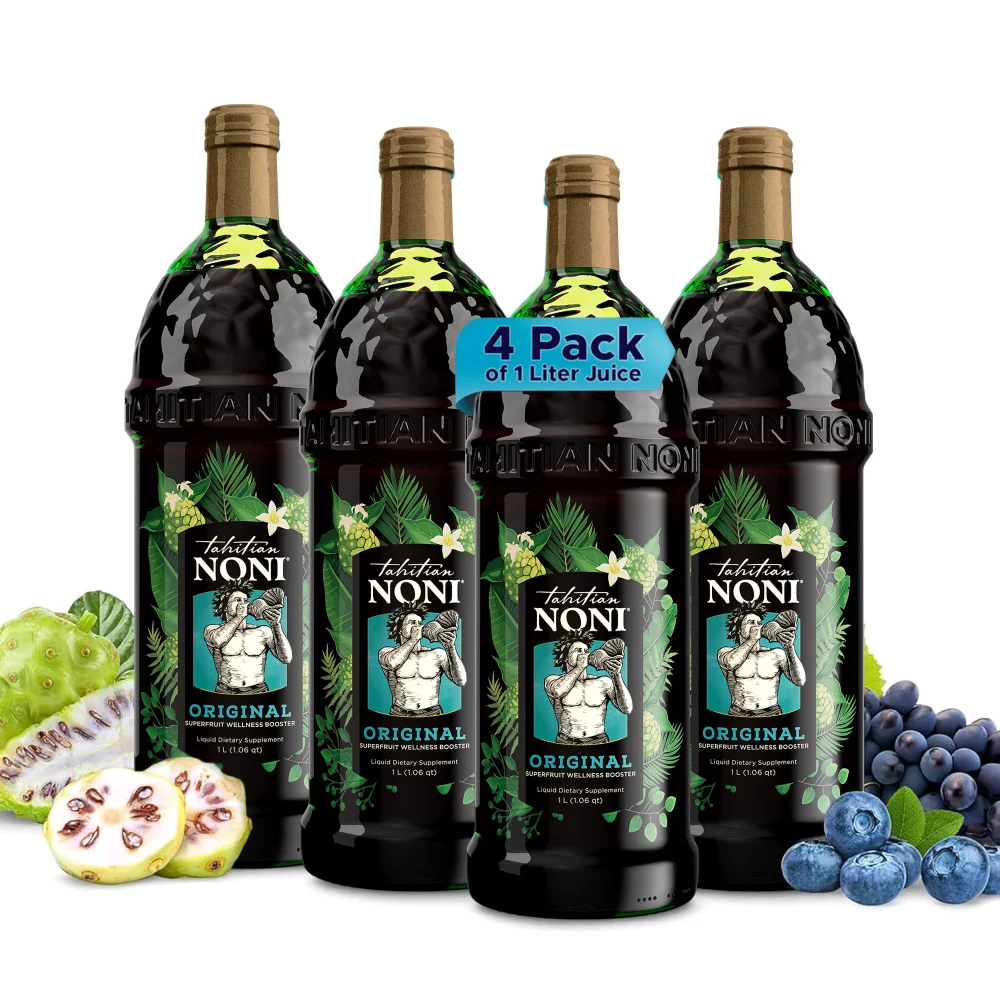
The four-bottle case is the same juice at $45.49 a litre, which is $1.38 a serving.
Why the glass is dark
Look along a shelf of juices and count the clear bottles. Light is what ages fruit juice fastest, driving the reactions that flatten colour and dull flavour, and a clear bottle under supermarket strip lighting is a slow accident that the manufacturer has decided the customer will not notice. Dark glass shuts most of that out.
Glass also holds oxygen off better than plastic does over months, which matters more than usual for a juice with no preservative in it. And a litre is a considered size: small enough that a household drinking a serving a day finishes it in about a month, large enough that you are not opening a fresh seal every week. Thirty-three servings, one seal.
None of that is styling, and it is the reason the bottle has looked the same since 1996 while everything around it on the shelf has been redesigned twice.
The part that goes wrong
Glass breaks. Read our reviews and you will find people whose bottle arrived cracked, and one who received two and lost one of them. We are not going to pretend that away: a litre of glass in a cardboard box is a heavier, more fragile parcel than a plastic bottle of orange juice, and a proportion of them do not survive the trip.
If yours arrives broken, that is a matter for the shop that took your payment rather than for us, and they replace it. Worth knowing before you order four.
What thirty years of not changing looks like
The first bottles went out in 1996, from a company set up that July around a fruit almost nobody in the United States could name. Since then the noni category has been through several waves of enthusiasm and at least as many of disappointment, and the shelf has filled with capsules, powders, extracts, concentrates, gummies and blends of noni with a dozen other fruits.
The bottle in our range is still a litre of dark glass with the same four ingredients on the panel. That is either stubbornness or confidence, and after thirty years the difference stops mattering. What it means for you is that the bottle you buy in 2026 pours the same way as the one somebody bought in 2006, which several of our reviewers say plainly and in their own words.
What we do not know, and will not guess
Every figure on this site comes off a label, a receipt or a calculator: the panel, the ingredient list, the price per litre, the research. Tree counts and line speeds belong in somebody else's brochure.
A number worth printing is one you can check against the bottle in your hand.
What a juice concentrate actually is
Two of the four names on our panel end in the word concentrate, and it is a word that has picked up a bad reputation it half deserves. A juice concentrate is juice with most of its water taken out, usually under vacuum at a low temperature so the fruit is not cooked. It travels as a syrup and takes up a fraction of the space, so almost every fruit juice that crosses an ocean crosses it in that form.
The reputation comes from what happens next. Reconstituted juice is concentrate with the water put back, sold as though nothing had been removed, and the difference between that and a fresh-pressed juice is real. But a concentrate used as an ingredient in a blend is a different matter: the blueberry and grape here are going in as flavour and colour alongside a purée, not being rebuilt into a pretend fresh juice.
The test is what sits first on the list. On our panel it is noni fruit nectar from purée. Water is not listed at all. On a bottle where water leads and a concentrate follows, you are looking at a reconstituted drink whatever the front of the label says, and that is worth knowing when you compare prices per litre.
Reading a noni label in a shop
If you are standing in front of a shelf rather than a screen, four things separate a bottle worth carrying home from one that is mostly water.
- The first ingredient. Noni purée or noni juice should lead. Water leading means you are buying a reconstituted drink.
- Added sugar. Look at the sugars line and the ingredient list together. Two grams a serving from fruit is one thing; ten grams with cane sugar named is another drink entirely.
- A named origin. French Polynesia, Hawaii, Fiji: a bottle that will not say where the fruit grew has decided not to tell you something.
- A figure for iridoids or phenolics. Not every honest bottle prints one. But a bottle that prints a number has committed to it, and a bottle covered in adjectives has not.
Four checks, about forty seconds, and they work as well on our bottle as on anyone else's. We would rather you ran them.
The short version
A tree that fruits all year. Fruit picked hard and ripened until it collapses. A purée nobody could drink, blended with two named fruit juices until somebody can. A litre of dark glass because light is the enemy, and a screw cap because you will open it thirty-three times.
Every figure above is off the panel or off a receipt, and the documents behind the iridoid line are listed with the date we read each one on our updates page.
That is the whole process, and the reason to know it is not romance. It is so that when you compare our litre with a cheaper one, you know which of those steps the cheaper one skipped.
Keep reading
Six steps, one purée, four names on the panel. What comes out of them is stocked in the Tahitian Noni litre, and the four-bottle case holds the cheapest litre.