Tahitian Noni · Journal · Noni, honestly: what the evidence says
Noni, honestly: what the evidence says, and what it does not
The National Institutes of Health say noni has not been shown to help any health condition in people. European regulators say it is unlikely to harm the liver at ordinary intakes. Both sentences are true, and here is what sits between them.

Writing this costs us sales, and we are writing it anyway. We sell noni juice, and the honest summary of the research on noni is that it has not been shown to do the things people buy it for. You would expect a brand to bury that. We would rather put it at the top, because you are going to find it anyway, and finding it after you have paid is worse for both of us.
Four public documents say what is below, in the order we read them, and they are linked at the end. None of them is ours. None of them was commissioned by anyone with a bottle to move.
First, the fruit
The tree is a small evergreen, Morinda citrifolia, growing across the Pacific islands, Southeast Asia, Australia and India, and unlike most fruit trees it carries fruit all year rather than in one flush. That one fact explains most of its history. A tree that always has something on it becomes a food you fall back on, and noni turns up in island diets not as a delicacy but as the thing you eat when the good food has run out.
The fruit is about the size of a small potato. Green going on white, knobbly, with a surface that looks like several smaller fruit fused together, which is roughly what it is. Ripe, it goes soft and translucent and smells sharply of fermentation. People who grew up around it describe the smell in terms that do not belong in a product description.
None of that is a criticism. It is the reason the juice in our bottles is blended: noni purée on its own is not a drink most people finish, and the blueberry and grape juice concentrates named on our panel are there to make a strong thing pourable.
What the National Institutes of Health say
The National Center for Complementary and Integrative Health is part of the National Institutes of Health, and its job is to summarise what is known about exactly this kind of product. Its page on noni was last updated in February 2025. The sentence that matters is short.
Noni has not been shown to have beneficial effects on any health condition in studies of people.
NCCIH, Noni: Usefulness and Safety, February 2025
Read it precisely, because the precision is the point. It does not say noni does nothing. It says the studies that would show a benefit in people have not shown one. Laboratory work on noni has found antioxidant and antimicrobial activity, and that work is real; it also does not tell you what happens when a person drinks 30 millilitres of a blended juice every morning. The distance between a cell culture and a human being is where most supplement marketing lives.
The same page is where the safety notes sit, and they deserve the same care. Several cases of liver toxicity have been reported in people who consumed noni juice or noni tea for several weeks. NCCIH adds, in the same breath, that it is unclear whether noni caused them. It notes that noni is high in potassium, which matters if your kidneys do not work as they should, and that noni might be safe when used for up to three months, a phrasing that tells you how thin the long-term data is.
What Europe found when it looked at the liver
Those liver reports did not go unexamined. Four cases of acute hepatitis in Austria sent the European Commission to the European Food Safety Authority, and in September 2006 its panel on dietetic products published what it found.
It is unlikely that consumption of noni juice at the observed levels of intake induces adverse human liver effects.
EFSA, re-assessment of the safety of noni juice, 6 September 2006
The panel was blunter still about the case reports themselves: it found no convincing evidence for a causal relationship between the acute hepatitis observed and the drinking of noni juice. Three years later, in an opinion adopted on 13 March 2009, the same panel assessed Tahitian Noni fruit purée and concentrate as a novel food ingredient, a document that names this purée specifically rather than noni as a category.
So you have two respected bodies, and they do not contradict each other as much as the headlines suggest. One says the benefits have not been demonstrated in people. The other says the harm has not been demonstrated either. Both statements are about the state of the evidence, not about the fruit.
| Document | Date | What it actually says |
|---|---|---|
| NCCIH, Noni: Usefulness and Safety | February 2025 | No beneficial effect shown in studies of people. Several liver-toxicity reports after weeks of use; cause unclear. High in potassium. |
| EFSA re-assessment of noni juice | 6 September 2006 | No convincing causal link between the reported hepatitis cases and noni juice. Adverse liver effects unlikely at observed intakes. |
| EFSA opinion on Tahitian Noni purée and concentrate | adopted 13 March 2009 | A European safety assessment of this purée and concentrate as a novel food ingredient. |
| NCCIH, Using Dietary Supplements Wisely | January 2019 | The FDA is not authorised to review supplements for safety and effectiveness before they are marketed. Talk to your own clinician. |
Full links, with the dates we read them, sit at the foot of the home page.
Why no bottle of noni carries FDA approval
You will see seals on noni bottles. Some of them are real certifications of real things: organic status, a manufacturing standard, a kosher or halal mark. None of them is FDA approval of the product, because that approval does not exist for dietary supplements. NCCIH puts it in one line: the FDA is not authorised to review dietary supplements for safety and effectiveness before they are marketed.
What that means in practice is that responsibility sits with the company. Federal rules say the maker must hold evidence that its supplement is safe and must keep its labels truthful and not misleading, and the agency can act after a product is on sale rather than before. A structure or function claim on a label, the kind that says a product supports something, has to carry a disclaimer saying the FDA has not evaluated it and the product is not intended to diagnose, treat, cure or prevent any disease. That disclaimer is not a formality. It is a fairly exact description of the legal position of every supplement on the shelf, including this one.
So our own pages carry no seal at all beyond the panel itself. We would rather show you a number than a badge.
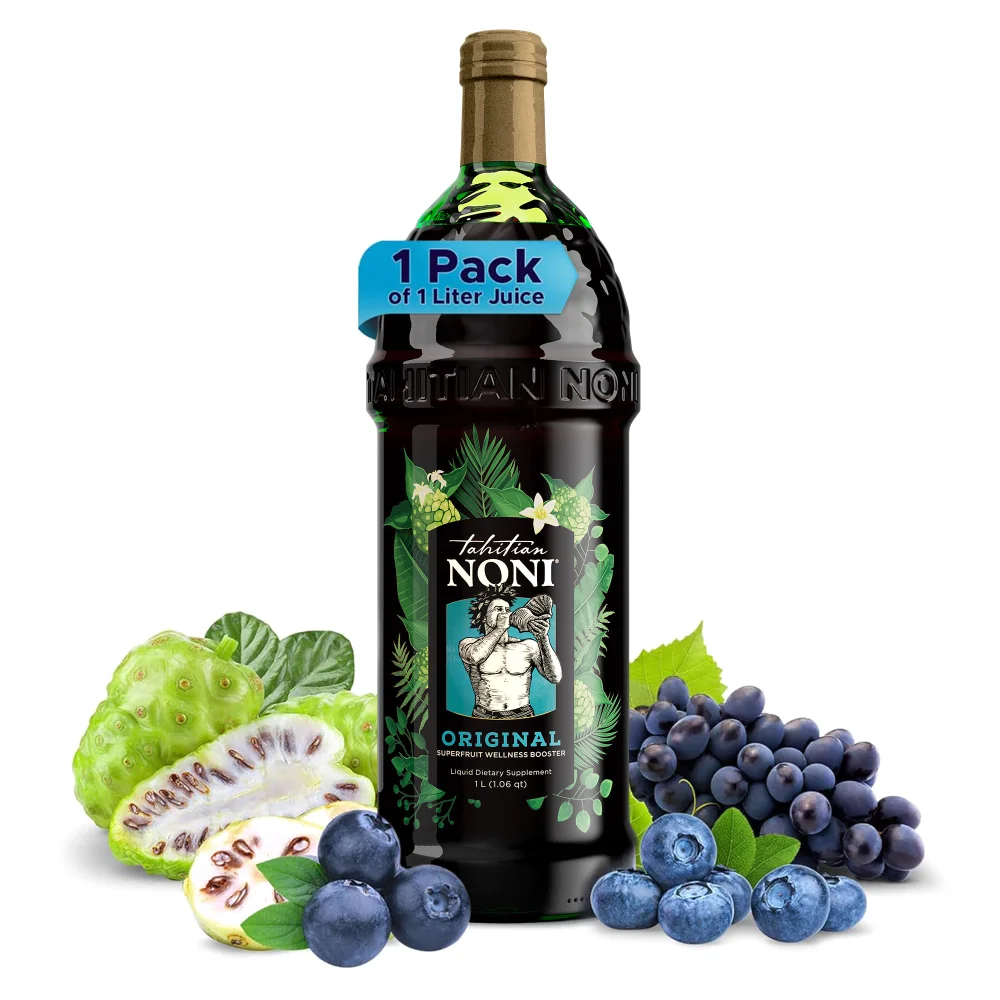
One litre
If you want to see the panel for yourself before reading further, the single litre is the cheapest way in.
The iridoid line, and what a dagger means
One figure on our panel confuses almost everybody: 15 milligrams of iridoids and phenolic compounds per 30 millilitre serving, printed beside a dagger rather than a percentage.
Iridoids are a family of plant compounds, and they are the reason noni gets studied at all rather than being left to the folklorists. Phenolic compounds are a wider family that turns up across fruit. The dagger means what the footnote says it means: no daily value has been established. Nobody has set a figure for how much of these a person should have in a day, because nobody knows. A percentage there would be an invention, so the label prints a dagger, and so do we.
It is worth pausing on how rare that is. A number with an honest admission of ignorance attached to it is more useful than a number dressed up as a recommendation, and if you are comparing noni bottles, a brand that prints its iridoid figure at all is telling you more than one that prints a landscape photograph.
The questions worth taking to a clinician
We are not going to tell you whether to drink this. We could not; we do not know what else you take, what your bloodwork looks like, or what your kidneys are doing. NCCIH advises talking to your own health care providers about any complementary approach you use, and on that we have nothing clever to add. But we can suggest what to bring to that conversation, because a vague question gets a vague answer.
- Bring the panel, not the brand. Thirty millilitres, 15 calories, 3 grams of carbohydrate, 15 milligrams of iridoids and phenolic compounds.
- Say how much and how long. A serving a day for a month is a different question from four servings a day indefinitely, and the three-month note on the NCCIH page is worth mentioning by name.
- Bring your medicine list. Interaction is the practical risk with any supplement, and it is the thing a pharmacist can answer in two minutes.
- Mention kidney or liver conditions if you have them. Potassium load is the specific reason, and it is on the NCCIH page.
- Say if you are pregnant or breastfeeding. There is not enough evidence either way, which is itself an answer.
What this site does claim
That the fruit purée in the bottle comes from French Polynesia and is named on the panel. That a litre holds about thirty-three servings. That the four-bottle case works out at $45.49 a litre and $1.38 a serving. That the juice is tart, strong and blended with blueberry and grape. That the bottle has been filled to this shape since 1996.
Everything on that list can be read off a label, a receipt or a calculator. Nothing on it is about a body.
Why we sell it anyway
A fair question, and it has a plain answer. It is a fruit juice that tastes like nothing else, out of a fruit the Pacific has eaten for centuries, carrying 15 milligrams of iridoids and phenolic compounds in every 30 millilitres. People drink it. Some have drunk it for twenty years and reorder the week they run out, and you can read them saying so on any of our bottles. That is a reason for a drink to exist. It is not a reason to promise anything.
The alternative, the thing most of this category does, is to take the laboratory work, skip the sentence about studies in people, and let a photograph of a waterfall do the rest. It sells better. It also means that every buyer who later reads the NCCIH page feels lied to, and they are right to.
So we print the panel, we link the research including the part that argues against us, and we do the arithmetic on the price so you can see what a month of mornings costs. If, having read all that, a tart fruit juice from French Polynesia is not what you want, you have lost nothing.
One last thing about reading noni claims
When you leave this page you will meet other noni sites, and there is a quick test for them. Look for the word "shown". A page that says a compound "has been shown" to do something in people should be able to point at the study, and usually cannot. A page that says a compound "may support" something is telling you, in careful legal English, that nobody has shown anything at all.
Then look for the panel. If a bottle will not tell you how many milligrams of anything are in a serving, the photograph of the island is doing all the work. That is the whole test, and it takes about forty seconds.
Before you drink it
This is a fruit juice and a food, and nothing on this site is medical advice. Noni has not been shown in studies of people to have beneficial effects on any health condition, and we make no claim that it does. Reports of liver problems in people drinking noni over several weeks exist and are linked below along with the European assessment that found no causal link; both are worth your time. If you are pregnant, breastfeeding, taking medicines, or living with kidney or liver disease, ask your own doctor or pharmacist before adding this or anything else to what you drink.
What we read, and when
- Noni: Usefulness and Safety National Center for Complementary and Integrative Health, National Institutes of Health · February 2025 · read 2026-08-28 The plainest statement we found on what the evidence does and does not show: noni "has not been shown to have beneficial effects on any health condition in studies of people". The same page records several reports of liver toxicity in people who drank noni juice or tea for weeks at a time, and notes it is unclear whether noni caused them.
- EFSA re-assesses safety of noni juice European Food Safety Authority · 6 September 2006 · read 2026-08-28 The other half of the liver question. After case reports of acute hepatitis, EFSA's panel found "no convincing evidence for a causal relationship" between those cases and noni juice, and concluded it is unlikely that drinking it at the observed levels of intake harms the liver.
- Opinion on the safety of Tahitian Noni® "Morinda citrifolia (noni) fruit puree and concentrate" as a novel food ingredient EFSA Panel on Dietetic Products, Nutrition and Allergies · adopted 13 March 2009, published 3 April 2009 · read 2026-08-28 The one regulatory document that names this purée specifically rather than noni in general: a European safety assessment of Tahitian Noni fruit purée and concentrate as a novel food ingredient.
- Using Dietary Supplements Wisely National Center for Complementary and Integrative Health, National Institutes of Health · January 2019 · read 2026-08-28 Why the label on this bottle carries no approval stamp and never could: "The FDA is not authorized to review dietary supplements for safety and effectiveness before they are marketed." The same page is where the advice to talk to your own clinician before adding anything comes from.
Keep reading
- From a fruit nobody wants to eat to a litre you will finish
- A month of mornings: taste, servings and cost per glass
Nothing above asked you to believe anything about a body. If the fruit juice itself still appeals, the Tahitian Noni line is three pack sizes and one panel, and the price per litre sits beside each of them.